
원문링크: https://www.sciencedirect.com/science/article/pii/S0960852421002066#!
연구배경
글리세롤로부터 3-hydroxypropionic acid (3-HP)를 효율적으로 생산하려면 조효소인 비타민 B12를 자체적으로 생산하는 균주를 사용하는 것이 필요한데 이를 위해 Pseudomonas denitrificans 가 사용되었다. 그러나 이 균주는 포도당을 기질로 자라지 못하고 대신 가격이 비싼 glutamic acid나 gluconic acid를 기질로 자라는 단점이 있다.
연구성과
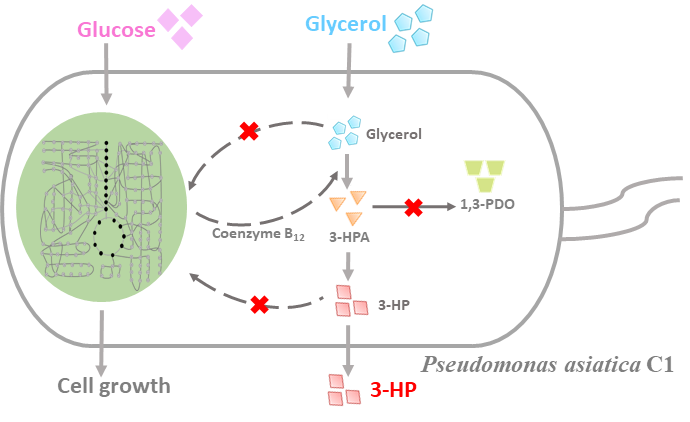
포도당을 기질로 잘 자라면서 동시에 비타민 B12를 잘 생산하는 균주를 자연환경에서 스크리닝하여 얻고 유전체 분석을 통해 P. putida와 99% 이상 유사성을 갖는 P. asiatica로 동정하였다. 3-HP 생산경로의 도입, 분해 경로의 제거, 글리세롤 흡수속도의 증가, PDO 등 경쟁경로의 제거, 탄소저해 현상 제거 등을 통해 70 g/L이상의 3-HP 생산이 가능한 균주를 확보하였다.
향후계획
P. asiatica를 대상으로 핵심효소 유전자 발현에 필요한 합성생물학 tool box의 개발이 진행되고 있다.
Abstract
Pseudomonas asiatica C1, which could grow on glucose and aerobically synthesize coenzyme B12, was isolated and developed as a microbial cell factory for the production of 3-hydroxypropionic acid (3-HP) from glycerol. Three heterologous enzymes, glycerol dehydratase (GDHt), GDHt reactivase (GdrAB) and aldehyde dehydrogenase (ALDH), constituting the 3-HP synthesis pathway, were introduced, and three putative dehydrogenases, responsible for 3-HP degradation, were disrupted. In addition, the transcriptional repressor glpR and the glycerol kinase glpK were removed to increase glycerol import while eliminating the catabolic use of glycerol. Furthermore, the global regulatory protein encoded by crc and several putative oxidoreductases (PDORs) were disrupted. One resulting strain, when grown on glucose, could produce 3-HP at ~ 700 mM in 48 h in a fed-batch bioreactor experiment, with the molar yield 〉0.99 on glycerol without much by-products. This study demonstrates that P. asiatica C1 is a promising host for production of 3-HP from glycerol.